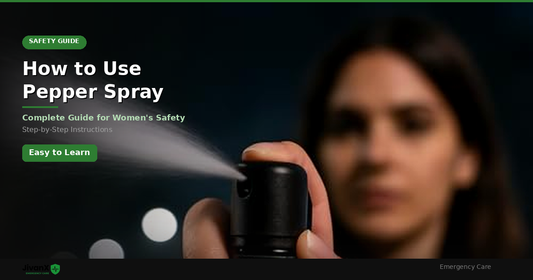
Every day, thousands of women across India carry a pepper spray in their bag — but most have never been trained to use it. That gap between carrying and being prepared is what this guide closes.
If you are searching for the best pepper spray for self-defense in India, this guide covers everything: how pepper spray actually works, why gel is better than stream for Indian conditions, the correct way to deploy it, and how to choose a product that will not fail you when it matters most.
Does Pepper Spray Actually Work for Self-Defense?
Yes — when used correctly, pepper spray is one of the most effective non-lethal self-defense tools available in India. Here is what happens when OC (oleoresin capsicum) contacts an attacker:
- Eyes: Immediate involuntary closure, intense burning, temporary blindness lasting 20–45 minutes
- Respiratory system: Coughing, choking, restricted breathing — makes it extremely difficult to pursue you
- Skin: Intense burning sensation that persists for 20–30 minutes
- Psychology: Shock and disorientation that breaks an attacker's focus
The effect is rapid — most attackers are incapacitated within 2–3 seconds of direct contact. This window is enough to run, seek help, or call for assistance.
One important caveat: cheap pepper sprays with very low OC concentration may cause only mild discomfort, not incapacitation. Formula quality matters enormously.
Is Pepper Spray Legal for Self-Defense in India?
Yes, completely legal. No license is required to buy, carry, or use pepper spray for personal self-defense in India. The right to self-defense is enshrined in Sections 96–106 of the Indian Penal Code, which recognizes your right to protect yourself from bodily harm using proportionate force.
Pepper spray is proportionate force in almost every realistic scenario — it incapacitates without causing permanent injury.
Key restriction to remember: Pepper spray is prohibited on all domestic and international flights in both carry-on bags and checked luggage. Leave it at home before flying.
For a detailed breakdown of the law by state and situation, read our comprehensive guide: Is Pepper Spray Legal in India?
Pepper Spray Gel vs Stream vs Mist: Which Is Best for Self-Defense?
Most people do not know there are three distinct pepper spray delivery formats. Choosing the right one is critical for self-defense effectiveness in India's conditions.
1. Mist / Fog (Avoid for Self-Defense)
Mist sprays atomize the formula into a fine cloud. The problems:
- Blowback risk: Even a light breeze blows the mist back toward you
- Short effective range: 6–8 feet in ideal conditions; less in wind or confined spaces
- Indoor hazard: Can affect bystanders and the user in closed rooms or vehicles
Mist-format pepper sprays are the cheapest and most commonly sold — and the least suitable for actual self-defense in India's climate and crowded environments.
2. Stream
Stream sprays project a focused liquid jet. Better than mist but still has drawbacks:
- Requires more accurate aim under stress
- Can drip and run off smooth surfaces
- Shorter shelf life after the seal is broken
3. Gel (Recommended)
Gel-format pepper spray is the professional choice — used by law enforcement agencies globally and increasingly by self-defense experts in India.
| Feature | Gel | Stream | Mist |
|---|---|---|---|
| Range | Up to 12–15 feet | 8–10 feet | 6–8 feet |
| Wind blowback risk | Very low — gel sticks | Medium | High |
| Accuracy under stress | Easier — thick consistency | Harder | Variable |
| Indoor safety | Safe — contained impact | Safe | Risky |
| Duration on attacker | Sticks and stays | Can run off | Disperses |
JivanX pepper spray uses a gel formula specifically engineered for Indian conditions: 12-foot range, no-blowback gel consistency, and a compact keychain-size design that fits in any bag or pocket.
How to Use Pepper Spray for Self-Defense: Step by Step
Carrying a pepper spray does nothing if you cannot deploy it in under 3 seconds under stress. Practice this sequence until it is automatic:
Before an Incident: Prevention Mode
- Keep it accessible — not at the bottom of your bag. Use the keychain clip on your bag strap or in an outer pocket.
- Know your release mechanism — most pepper sprays have a safety clip or twist lock. Practice removing it smoothly with one hand.
- Stay situationally aware — if you sense danger, have the pepper spray in your hand before the situation escalates, not after.
During an Incident: Deployment
- Create distance first — step back 3–4 feet if possible. This puts you at optimal range (8–12 feet for gel) and outside arm's reach.
- Grip firmly — thumb on the trigger, index finger steady. Do not hold it loosely or it can be knocked away.
- Aim for the face — specifically the eyes and nose area. A center-face sweep is more effective than trying to target a specific eye under stress.
- Short, controlled burst — 1–2 seconds of spray is sufficient. Do not empty the entire canister.
- Shout clearly — "Back off!" or "Stay away!" — this draws attention from bystanders and signals you are defending yourself.
- Run immediately — do not wait to see the effect. Turn and move toward people, a shop, or any public space. The goal is escape, not confrontation.
After an Incident
- Move to a safe, public location immediately
- Call 112 (police emergency) if required
- If affected by blowback: flush your own eyes with cold water for 15–20 minutes; do not rub
Choosing the Right Pepper Spray for Self-Defense in India
The Indian market is flooded with cheap sprays that look identical to effective ones but have negligible OC concentration. Here is what to look for:
1. OC Concentration — The Most Important Spec
Look for at least 1.3% major capsaicinoids (not just OC percentage — that number can be misleading). The capsaicinoid content is what determines actual stopping power. Many cheap Indian sprays list OC percentage but not capsaicinoid content — a warning sign.
2. Formula Type
Choose gel over stream or mist, especially for outdoor use where wind is a factor, confined spaces (vehicles, stairwells, lifts), and situations where bystanders may be nearby.
3. Range
For a self-defense tool, range is safety. The further you can deploy the formula while maintaining a safe distance, the safer you are. Look for a minimum of 10 feet range; 12 feet is ideal.
4. Size and Carry Design
The best self-defense tool is the one you actually carry every day. Choose a compact, keychain-compatible design that fits in a jeans pocket or outer bag pocket, with a safety mechanism removable with one hand.
5. Shelf Life and Expiry
All pepper sprays have an expiry date — typically 2–4 years. Check before purchase. A pepper spray past its expiry may have degraded OC content and reduced effectiveness.
JivanX Pepper Spray — Built for Indian Self-Defense Conditions
JivanX gel pepper spray addresses every requirement above:
- 12-foot range — more distance between you and the threat
- Gel formula — zero blowback risk, stays on target, safe indoors
- Compact keychain design — fits any pocket or bag strap
- Verified OC concentration — not a watered-down formulation
- Made in India — designed for Indian weather conditions (heat, humidity, dust)
Available at jivanx.com with direct-to-door delivery across India.
Common Mistakes That Reduce Pepper Spray Effectiveness
Mistake 1: Keeping it in an inaccessible location
Digging through your bag under stress takes 10+ seconds. The attacker does not wait. Use a keychain clip or outer pocket.
Mistake 2: Never practicing the deployment motion
The safety mechanism, grip, and aim sequence should feel automatic. Practice with an empty or expired canister at home.
Mistake 3: Spraying from too close
At under 3 feet, you risk blowback and reduce the psychological effect of range. Step back, create distance, then deploy.
Mistake 4: Using an expired spray
OC degrades over time. An expired spray may work at 30–50% effectiveness — not enough to stop a determined attacker.
Mistake 5: Buying the cheapest option
Pepper spray prices in India range from ₹75 to ₹999. The cheapest options often have negligible OC content and will cause irritation, not incapacitation. This is not a product where saving ₹200 is worth the tradeoff.
Pepper Spray for Self-Defense: Situations Where It Works Best
Solo Travel
On trains, buses, autorickshaws, and late-night rideshares — having pepper spray accessible provides both confidence and protection. The ability to incapacitate an attacker and immediately flee to a public area is especially valuable in transit situations.
College and Campus Safety
For students living away from home, a compact pepper spray in the bag is one of the simplest safety additions. It is lightweight, requires no training course, and does not draw attention when carried.
Nighttime Walking or Commuting
Women walking from metro stations, bus stops, or late-night work shifts benefit most from an accessible, high-range gel spray that works even in low light conditions where aim is harder.
Parking Lots and Isolated Areas
Carjacking and harassment in isolated areas is a real risk. A pepper spray clipped to your keys means it is already in your hand when you are walking to your car.
Summary: How to Choose and Use Pepper Spray for Self-Defense in India
| Decision | Best Choice | Why |
|---|---|---|
| Formula | Gel | No blowback, longer range, sticks to attacker |
| Range | 10–12 feet minimum | Distance = safety margin |
| Size | Keychain / pocket size | Accessibility matters more than capacity |
| OC quality | Verified major capsaicinoids | Stopping power depends on this |
| Carry method | Clipped to bag strap or outer pocket | 3-second access rule |
| Practice | Monthly dry-run of deployment | Under stress, only muscle memory works |
Pepper spray for self-defense in India is legal, effective, affordable, and practical. The barrier to using it is not buying it — it is developing the habit of carrying it correctly and knowing how to deploy it in under 3 seconds.
If you are ready to carry with confidence: Shop JivanX Pepper Spray
JivanX makes emergency care products for everyday Indians — anti-choking devices, pepper spray, and first aid kits. Made for India. Tested for real conditions.
Tags:
Previous
Best Pepper Spray for Women in India 2026 — Complete Safety Guide
Next
महिलाओं के लिए Pepper Spray: 2026 की सम्पूर्ण गाइड — क्या खरीदें, कैसे इस्तेमाल करें, और कौन सा Gel Formula सबसे अच्छा है?